

What Is IRP in Trucking? Cab Cards, Apportioned Plates, and How to Apply
If you drive a truck over 26,001 lbs GVWR/GCWR or has 3 or more axles across state lines, you need IRP registration and a cab card. These are not optional, and without them, you risk fines and some hefty violations.
This article covers what IRP is in trucking, what a cab card (sometimes called a cabcard) is, who needs one, and how to file your IRP application.
Quick Summary
IRP stands for the International Registration Plan. It's a registration agreement that lets commercial vehicles travel across U.S. states and Canadian provinces under one "apportioned" registration. Total Insight Professional Services (TIPS) can handle your entire IRP application. Obtain your IRP filing here.
When you register under the IRP, your base state gives you IRP apportioned plates and a document called a cab card. The cab card proves your vehicle is registered. It lists every state you're allowed to operate in, and it must stay in the truck at all times. If your vehicle or combination weighs over 26,000 lbs (or the power unit has 3 or more axles) and crosses state lines, you need IRP registration.
What Is IRP? The International Registration Plan Explained
What does IRP stand for? IRP stands for the International Registration Plan. It's an agreement between the lower 48 U.S. states, Washington D.C., and ten Canadian provinces. The goal is simple: make it easier to register trucks that travel across state lines.
Before the IRP, carriers who drove in more than one state had to get separate plates and paperwork for each one. That was a mess. The IRP fixed this with a single "apportioned" registration.
Here's how it works. You register your fleet in your home state. This is called your "base jurisdiction." Your fees are then split between all the states your trucks run in. The split is based on vehicle class and how many miles you drive in each state. Once approved, your base state gives you your IRP apportioned plates and your cab card. Your IRP number is your account ID. It shows up on all your paperwork.
In simple terms, IRP registration is what gives you the legal right to drive a qualifying truck across state lines.
IRP and IFTA: What's the Difference?
New carriers mix these up all the time. IRP and the International Fuel Tax Agreement (IFTA) are often handled together, but they cover different things:
IRP covers vehicle registration (your plates and your right to operate).
IFTA covers your IFTA license / stickers & fuel tax reporting.
Both IRP and IFTA need you to track your miles in each state. That's why most carriers deal with them at the same time. If a service handles your IRP, they should also handle your IFTA filings. This keeps your records straight.
Who Needs IRP Registration?
You need IRP registration if your vehicle hauls across state lines and meets any of these:
Has two axles and a gross vehicle weight rating (GVWR) over 26,000 pounds.
Has three or more axles, no matter the weight.
Is part of a combo where the total weight rating (GCWR) is over 26,000 pounds.
If you only drive within your home state, you don't need IRP. But the moment a truck that meets these rules crosses a state line, it needs to to have apportioned registration via IRP.
What Is an IRP Cab Card?
The cab card is a document your base state gives you. It proves your vehicle is registered under the IRP. It’s essentially like a passport for your truck.
Your IRP cab card shows your company name and IRP account number, the vehicle's VIN, year, make, and plate number, the weight the vehicle is registered at, every state you're allowed to run in, and the date your registration expires.
For example, a typical IRP cab card might show a 2023 Kenworth T680 registered at 80,000 lbs. It would list states like Idaho, Oregon, Washington, Utah, Montana, and Wyoming, along with the carrier's name, IRP account number, and expiration date.
An officer at a weigh station or roadside check will ask for this document. The original cab card must be in the truck at all times. If you can't show a valid, original cabcard, you'll get a penalty.
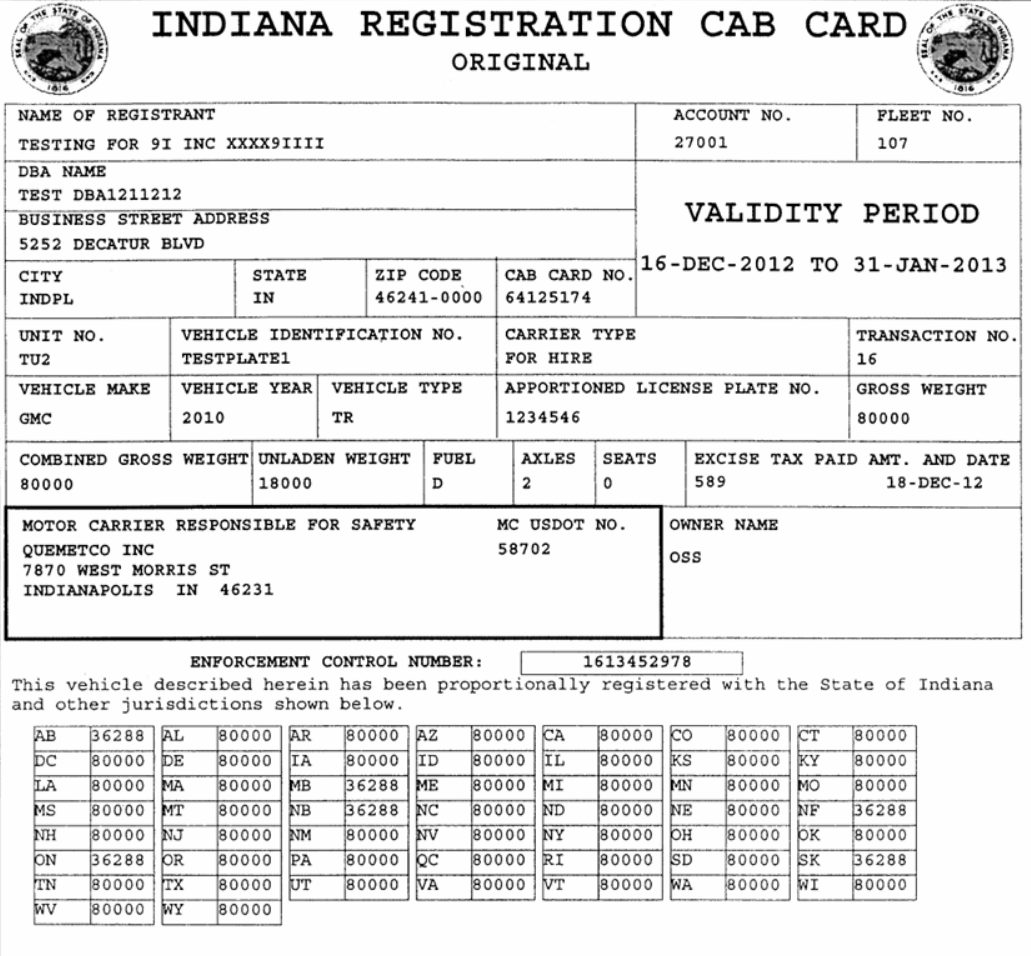
Example of what a cab card looks like.
How to File IRP: Getting Your Registration and Cab Card
You can file IRP online through your state's portal or work with a service like TIPS. Either way, the overall steps are the same. Here's what a new IRP application looks like.
Step 1: Pick Your Base State
Your base state is where your business is located and where you keep your fleet records. You'll need to prove this with things like utility bills, a lease, or incorporation papers.
Step 2: Gather Your Documents
Your state's IRP office needs a specific set of paperwork. Getting this right matters. Mistakes lead to rejection. Be ready with:
Proof of Business: Your USDOT Number, EIN (Employer Identification Number), and articles of incorporation.
Proof of Address: A valid driver's license and proof of address for where your business is based.
Vehicle Info: Original vehicle titles (or copies, if leased).
Heavy Vehicle Use Tax (HVUT): A stamped IRS Form 2290, Schedule 1, for any vehicle with a GVW of 55,000 pounds or more.
Lease Agreement: If the vehicle is leased, a copy of the signed lease.
Step 3: Fill Out the IRP Application and Estimate Your Miles
You'll fill out your state's IRP application and list each vehicle. As a new carrier, you won't have a mileage history yet. Your state gives you an average distance chart to work from. Use it to estimate what share of your miles will be in each state. Good estimates help you get the right fee amount.
Step 4: Pay Your Fees and Get Your Plates
Once your IRP application is approved, you'll get a bill. Your registrations costs are based on your vehicle, and the miles you plan on travelling across various states. After you pay, your base state sends your IRP apportioned plates and official cab cards. Once those are on your trucks, you're good to go.
Frequently Asked Questions About IRP
-
No. IRP registration is only for vehicles that cross state lines. If you only operate within your home state, standard state registration is all you need.
-
IRP fees vary based on your vehicle weight, the number of states you operate in, and how many miles you drive in each one. As a general range, hot shot carriers may pay $500 to $1,000 per vehicle, while semi-trucks typically run $1,200 to $2,500 or more. Fees change every year because they're based on actual miles traveled. You can get an estimate using the IRP Fee Estimator on the official IRP website.
-
If you can't show a valid, original cab card at a roadside inspection or weigh station, you may face fines, and in some cases your vehicle can be placed out of service or impounded. The penalties vary by state. A missing or expired cab card also adds points to your CSA score, which can hurt your safety record.
-
Processing times vary by state. TIPS generally recommends to prepare for a 4-6 week processing period once your application has been submitted. Many states offer temporary permits so you can operate while your permanent credentials are being processed.
-
If your vehicle meets the IRP weight or axle requirements and you cross state lines, you will likely need both. IRP covers your registration. IFTA covers your fuel tax reporting. They are separate filings, but most carriers apply for both at the same time.
Let the Experts Handle Your IRP Compliance
IRP and IFTA applications trip up a lot of carriers. Every state has its own rules. Picking the wrong form, missing a document, or choosing the wrong registration class can all cause delays that cost you money.
That's where Total Insight Professional Services (TIPS) comes in. We handle the entire IRP application process for you, from new accounts to yearly renewals. Our team knows what each state needs and gets your application filed right the first time.
Whether you want help learning how to file IRP online or just want someone to take care of the whole thing, we've got you covered. We handle the paperwork. You get your trucks on the road faster.
Click Here to Get Your IRP Application Started Today or Contact Us for more information.